Make your own audiobook+Make your own audiobook
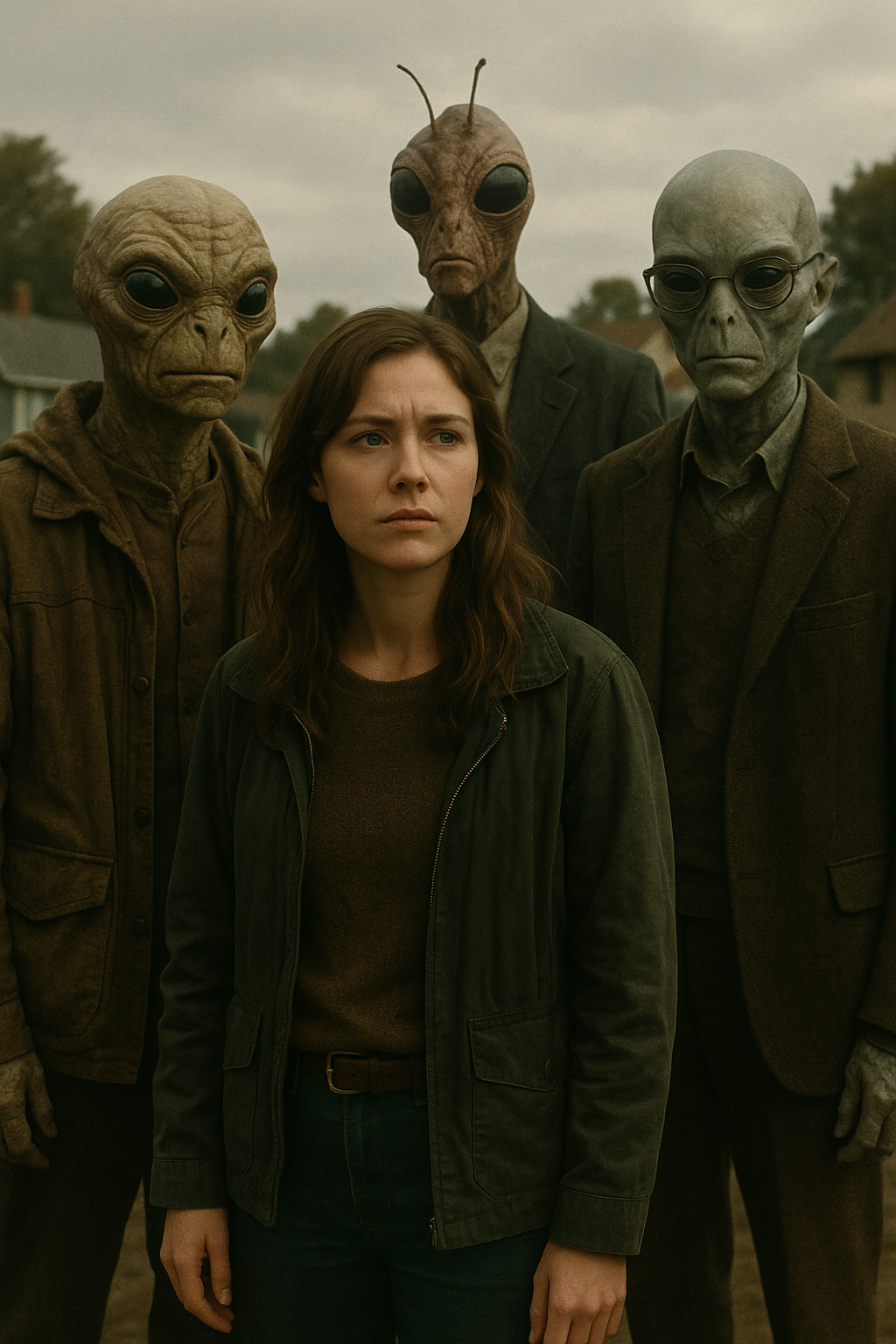
Poster for Grey Loch

Grey Loch

From Grey Loch

Four alien species coexist secretly on Earth, treating humanity as an elaborate zoo while subtly manipulating world leaders and staging absurd interventions in human affairs. When their annual gathering—the Oddities Festival at Grey Loch—approaches, a human stumbles onto the truth that the quirky strangers running the local science fair and advising the government are actually competing to see who can orchestrate the most outrageous influence over civilization. Now caught between warring alien factions with conflicting agendas, the human must navigate impossible alliances, cross-species romance, and the question of whether to expose them or exploit the chaos for their own gain.

Graphene
Written. Spoken. Yours.
Graphene
Written. Spoken. Yours.
←

Grey Loch

🥽 VR
6 chapters · ~28 min read

novella

Four alien species coexist secretly on Earth, treating humanity as an elaborate zoo while subtly manipulating world leaders and staging absurd interventions in human affairs. When their annual gathering—the Oddities Festival at Grey Loch—approaches, a human stumbles onto the truth that the quirky strangers running the local science fair and advising the government are actually competing to see who can orchestrate the most outrageous influence over civilization. Now caught between warring alien factions with conflicting agendas, the human must navigate impossible alliances, cross-species romance, and the question of whether to expose them or exploit the chaos for their own gain.

Made with EmberKiln
Chapter 1 · ~4 min read

Strangers at the Science Fair

7:03

The banner over the entrance read GREY LOCH ANNUAL SCIENCE FAIR — WONDER AWAITS, hand-lettered in the kind of optimistic blue that doesn't survive a Saturday drizzle. One corner had already peeled free from its lamppost and was applauding itself, slowly, against the wet metal. Alex stood underneath it with both hands jammed in coat pockets and watched the corner flap for longer than was reasonable.

•••

Alex had come because the alternative was reorganizing the spice cabinet. This is the kind of admission you make to yourself in a town like Grey Loch, where the fog rolls in off the water four days out of seven and the weekend options narrow to: drink, drive somewhere, or attend whatever the community center has put up flyers for. Alex was twenty-nine, had moved back two years ago for reasons that sounded better at the time, and had developed a low-grade allergy to the question what are you doing with your life. The science fair was, at minimum, a place where no one would ask.

•••
“

This is the kind of admission you make to yourself in a town like Grey Loch.

Inside the hall, the air smelled like wet wool and warm electronics. A folding-table economy of trifold posters and dim LEDs, the usual middle-school volcanoes, a kid with a potato battery, a retiree who had built a small wind turbine out of bicycle parts and was very willing to explain it. Alex did one polite loop, nodded at the librarian, accepted a pamphlet about soil acidity, and was preparing to leave when the back third of the room registered as wrong.

•••

It wasn't the inventions, exactly, although the inventions were the thing you noticed first. A man in a corduroy blazer was demonstrating what he called a passive thermal inverter, which appeared to be a copper bowl that made ice cubes from room-temperature water without being plugged into anything. He'd set up a hand-lettered sign reading PLEASE DO NOT TOUCH (HOT) next to a bowl that was visibly frosting over. Two booths down, a woman with a French braid was selling, or possibly just displaying, a small black cube that hummed at a pitch Alex felt in the molars. Her sign said MEMORY LATTICE — ASK ME ABOUT STORAGE. She was not asking anyone about storage. She was watching the man with the copper bowl with an expression you'd want a lawyer present for. And then there was Dr. Voss.

•••

Her booth was the cleanest in the hall, which was its own tell. White cloth, white backdrop, a single device on a stand that looked like a music box crossed with a tuning fork, and a small placard reading QUANTUM RESONANCE — DEMONSTRATIONS HOURLY. Dr. Voss had silver eyes. Not grey, not pale blue. Silver, the way a coin is silver, and she met Alex's gaze across the room with the unhurried interest of someone identifying a bird. Alex went over. "What does it do," Alex said, which was meant to be casual and came out flat. "It resonates," said Dr. Voss, brightly. "Quantumly." "Right. With what." "Oh, with whatever's nearby that wants to." She smiled. Her teeth were very even. "Would you like to see it hum?"

•••

It hummed. It hummed in a way that made the overhead fluorescents stutter, just for a second, just enough that Alex glanced up and Dr. Voss did not. When Alex looked back, the man from the copper bowl booth was suddenly at Alex's elbow, holding out a paper cup of cider with both hands, saying something warm and meaningless about the rain. By the time Alex had taken the cup and turned around, Dr. Voss was deep in conversation with the braid woman, and the music box was covered with a cloth.

•••

This happened three more times in the next forty minutes. Alex would drift toward the white booth. Someone would intercept. A pamphlet, a question, an offered cookie, once an entire unsolicited explanation of magnetism from a man who introduced himself as Bram and did not blink for the duration. They were polite. They were relentless. They were, Alex began to suspect, coordinating. The badge was on the floor near the coffee urn. A standard plastic clip-on, EXHIBITOR printed across the top in the same optimistic blue as the banner outside. Alex bent to pick it up, meaning to hand it back to whichever absent-minded inventor had dropped it, and read the name. MARGARET ELLISON KEYS.

•••

Alex knew that name. Alex's mother had clipped the obituary in 1987 and kept it in the drawer with the good silverware, for reasons Alex had asked about once and been told, gently, to leave alone. Margaret Ellison Keys had been a chemistry teacher at the high school. Margaret Ellison Keys had died in a car accident on the coast road the spring before Alex was born. Same spelling. The middle name was the part you didn't make up.

•••

The lamination at the corner of the badge had lifted slightly, the way an old sticker peels when the glue gives out, and underneath the printed name was something else. A mark. Not a logo Alex recognized, not a letter from any alphabet Alex had sat through a class on. Three curved lines meeting at a point, with a small unfilled circle floating above where they joined. Alex held the badge closer to the light and the mark seemed, briefly, to be the wrong color for the paper it was printed on. Alex looked up.

•••

Across the hall, Dr. Voss had turned toward Alex. So had the man with the copper bowl. So had the woman with the braid. None of them had spoken first. None of them were looking at each other. They were looking, all three, at Alex, with the same small attentive tilt of the head, as if listening for something Alex had not yet said. The banner outside slapped wetly against its lamppost. Inside, no one moved. Alex put the badge in a coat pocket.

•••
Next · Ch 2 →
The Alien Agenda Exposed
Chapter 2 · ~5 min read

The Alien Agenda Exposed

7:16

The supply closet behind the main stage was lit by a single fluorescent tube that buzzed at a pitch just shy of a headache. Folded tablecloths sat in uneven stacks, smelling of mildew and, underneath that, something faintly electrical, the way a transformer smells in the rain. Alex had ducked in because the third round of the Improbable Engineering Showcase had asked contestants to demonstrate a working perpetual motion device, and one of them appeared to be doing it, and Alex needed thirty seconds of dim light to think about what that meant. The door across the closet opened before Alex could process that there was a door across the closet.

•••

There is a particular physics to hiding. You do not choose where to hide. The room chooses for you, and you obey, and you do it before your brain has finished the sentence about why. Alex was behind a wheeled rack of folded chairs in the time it took the overhead bulb to flicker once. Two people came in. One of them was the woman from the white booth, the one with the badge that read Dr. Voss in a font that looked slightly wrong, the way hotel art looks slightly wrong. Her eyes, in this light, did not behave the way eyes behave. The other was a man Alex had not seen before, broad shouldered, lower voice, the kind of presence that fills a room without arranging itself for the room. "You're early," Voss said.

•••
“

You do not choose where to hide.

"They're earlier." He set something on a shelf. "By a week, maybe more. They've already moved on the financial desks in three capitals." "Three." "Three that we know." Alex's hand found the phone in their pocket and turned the side switch to silent with the slow, deliberate motion of someone defusing a thing. The screen, face down against denim, would still light up if a notification came through. Alex pressed it harder into the fabric, as if pressure could mute the world. "How long do we have," Voss said. It wasn't a question. "Seventeen days to the gathering. They want narrative control before anyone sits down." A pause. Then a small, precise sound, like a watch face being tapped, and the air above the lowest shelf began to glow.

•••

Alex had seen holograms before. Trade shows, museum lobbies, the lobby of a dentist's office that was, in retrospect, trying too hard. This was not that. This was a globe rendered in a blue so thin it seemed to be made of the idea of blue, and it turned slowly between them, and it had pins in it. Small red pins, dropped at points Alex recognized without wanting to. A pin sat over a city in Japan that Alex's grandfather had a quiet, lifelong opinion about. A pin sat just above the curve of the Earth, where no city is. A pin sat on lower Manhattan, and the date floating beside it was a year Alex remembered for the sound of their mother on the phone with the bank.

•••

"The zoo is restless again," the man said. He said it the way a vet says a dog is off its food. Voss looked at the map for a long moment. "It's restless because we've been pulling the levers harder. They feel it even when they can't name it." "Then we pull first. Before the others do. We move on the desks, we move on the press, we set the frame, and when everyone sits down at the gathering, the story is already ours." "That isn't how we do this." "It's how they're doing it." "It isn't how we do this," she said again, and the second time the sentence had a weight to it, a place it came from. "Not with the archive"

•••

She didn't finish. She glanced toward the door Alex had come through. Her head tilted, very slightly, the way an animal's does when a sound has happened that hasn't happened yet. Alex stopped breathing in the middle of a breath. Stopped it cleanly, as if a hand had been laid across the mouth from the inside. The rack of chairs in front of them suddenly felt like a suggestion of a hiding place rather than a hiding place. A folded tablecloth on the top shelf began, very gently, to slide. "What," the man said. Voss did not answer for what Alex would later swear was a full ten seconds and was probably two. Then she said, "Nothing. Finish."

•••

He finished. He spoke of the press, of two senators who were not, it turned out, entirely doing their own thinking, of a meeting in a building Alex had seen on the news without ever wondering who cleaned it. He spoke of humans the way a farmer speaks of a field, with affection and inventory. The hologram turned. The pins did not move; they had already done their work. When the lights in the little blue Earth went out, the closet was darker for a moment than it had been before they came in. Then the door opened and closed and the buzzing tube was alone again with its job.

•••

Alex stayed behind the chairs through a count that was supposed to be sixty and became one hundred and twenty because the first count did not feel honest. The tablecloth on the top shelf finished its slow slide and dropped to the floor with the softest sound a piece of cloth can make, and Alex did not flinch, because flinching was a luxury for people who had not just learned what they had just learned. The corridor outside was empty. Fluorescent, ordinary, smelling of popcorn from somewhere far away. Alex walked the first ten feet without remembering walking them. At the end of the hall a child was crying about a ribbon. A woman was laughing into a phone. A man in a vendor's apron was carrying a tray of small paper cups.

•••

Alex stopped at the metal door at the end of the corridor and put a hand flat against it to steady themselves. The metal was cold. The hand was not. When Alex took the hand away, a print remained, the shape of a palm and five fingers, slightly damp, already beginning to thin at the edges. By the time Alex reached the exit it would be gone. By the time anyone thought to look, there would be nothing there at all.

•••
← Previous · Ch 1
Strangers at the Science Fair
Next · Ch 3 →
Caught in the Crossfire
Chapter 3 · ~5 min read

Caught in the Crossfire

7:42

The bicycle lay on its side at the edge of the access road, the back wheel still turning, slow and uncomplaining, the way a wheel turns when nobody is coming back for it any time soon. A reflector clicked once against the asphalt. Somewhere behind the trees, the science fair tents were being struck. Nobody had seen Alex run. That was the official story, anyway. What actually happened, between the closet and the bicycle and the bait shop where Alex is now sitting on an overturned milk crate, is the kind of sequence a person reconstructs later in fragments. A hand on the elbow that felt too warm through the sleeve. A voice saying, very pleasantly, we'd like to continue your visit. A short walk that became a longer walk. A door with a brass bell that someone had taped down so it wouldn't ring.

•••

The bait shop sits at the south end of Grey Loch, on stilts, smelling of diesel and old nightcrawlers. The Voss faction, if Alex had a name for them, which Alex does not, have converted the back room into something that wants very badly to look casual. A folding table. A thermos. A man by the door who has not blinked in a length of time Alex has stopped measuring. Alex's bag is on the table. The phone is in the bag. The notebook, the one with the badge symbol sketched four different ways across the inside cover, is in the bag. The bag is six feet away and might as well be in orbit.

•••
“

What actually happened, between the closet and the bicycle and the bait shop is the kind of sequence a person reconstructs later in fragments.

The woman, the clipped one, the one who used the word elegant like a scalpel, came in once, looked at Alex the way a person looks at a thermostat, and left. That was forty minutes ago. Maybe fifty. The window above the sink looks out on the loch, and the loch, this time of year, is the temperature of a held breath. Alex has already done the math on the window twice and arrived, both times, at the same answer, which is: probably, but. The but is the man.

•••

He came in twenty, twenty-five minutes ago, with two coffees, neither of which he drank. He sat across from Alex on a second milk crate and rested his forearms on his knees and said, in that conversational register that isn't quite a register a human throat produces, if you wanted to leave, you could leave. He said it like a question that was also an apology. He said, if it helps, I don't think this is how any of this should be going. Then he slid an envelope across the table.

•••

Inside the envelope was a photograph of Alex's front door. The brass numbers. The mat that says nothing because Alex hates mats that say things. In the corner of the photograph, a timestamp. This morning. 7:14 a.m. Alex had been inside the house at 7:14 a.m., drinking coffee, not yet a person anyone was watching, or so Alex had thought. He didn't say, this is a threat. He said, I want you to know what they already have. He said it the way you tell a friend their tire is low. Then he stood, and said he'd wait at the diner across the road for as long as he reasonably could, and left a key on the table. A small one. The kind that opens a padlock on a back door. That was eight minutes ago. Maybe nine.

•••

The man by the door shifts his weight. The wheel of Alex's bicycle, two hundred yards away, has by now stopped turning, though Alex doesn't know this. Alex is doing the only useful thing left, which is breathing in through the nose and out through the mouth and counting backwards from a number that keeps resetting. Here is what the photograph did. It made the window stop being a window and start being a math problem with a different variable. Because if the Voss faction has been at the door since this morning, then the Voss faction was at the door before the closet, before the overheard conversation, before any of it. Which means Alex was not noticed at the fair. Alex was noticed earlier. Which means the closet wasn't the moment. The closet was the confirmation.

•••

Alex stands up. The man by the door does not move, exactly, but the air around him organizes itself. Alex says, I need the bathroom. The man considers this for a fraction of a second too long, and then nods toward a door at the back of the room. Alex walks to it. Passes the table. Does not look at the bag. Does not look at the bag. Looks at the bag. Keeps walking. The bathroom door closes. There is a window above the toilet, small, single-paned, latched from the inside. The latch is painted shut. Alex breaks a fingernail on it and gets it open anyway.

•••

The drop to the dock is shorter than the drop to the water. The dock is empty. The diner sign across the road is visible between two pines, red neon, the O flickering. Alex doesn't have the bag. Alex doesn't have the phone. Alex has the small key, in a fist, and a cut along the meat of the thumb that is bleeding into the palm. Alex runs. The diner is the kind of diner that has survived three different owners by changing nothing. The man is in the back booth. He sees Alex come in and his shoulders drop a full inch, which is the first thing all day that has looked like an honest reaction. He slides a mug across without asking. He says, I wasn't sure. He says it almost to himself.

•••

Alex sits. The cut on the thumb is on the napkin now, a small red comma. The man looks at it, and something passes across his face that the woman, the clipped one, would never permit on hers. He reaches into his jacket and produces a folded handkerchief, and hesitates, and sets it on the table instead of handing it over, as if he has remembered, mid-gesture, some rule about contact. He says, they'll know within the minute. He says, we should talk fast.

•••

Across the road, at the far end of the empty stretch of two-lane that runs past the diner and the bait shop and the turnoff to the loch, a black car is idling. Its headlights are off. Its engine is on. At the other end of the same stretch, maybe two hundred yards south, a second black car sits in exactly the same posture, facing the first. Neither car moves. The diner sign flickers. The O catches, holds, catches. The wheel on the bicycle, somewhere behind all of this, has been still for a while now.

•••
← Previous · Ch 2
The Alien Agenda Exposed
Next · Ch 4 →
The Truth Uncovered
Chapter 4 · ~5 min read

The Truth Uncovered

7:37

The door was set into the hillside above Grey Loch, half-swallowed by gorse, and the handle had been worn to a bright nickel by hands that were not, strictly speaking, hands. Alex noticed this in the way one notices a missing step. The shine was wrong. The gorse had been trained around it, not grown. Behind them, somewhere down the slope, a voice was calling their name in a register that didn't quite settle on a vowel. Alex turned the handle. The door opened inward onto cold air that smelled of paper and ozone. A staircase. A hum. At the bottom, a long room lit by recessed strips the color of moonlight on snow, and rows of filing cabinets that ran further than the room ought to have allowed.

•••
“

The shine was wrong.

A panel by the door pulsed. Once, twice. Then a soft chime, almost domestic, and a band of amber crawled across the ceiling from the far wall toward the stairs. Alex didn't need the manual to understand. Something had registered an unauthorized entry. Something was closing. They moved. The cabinets were labeled, but not in any alphabet Alex could read. The drawers bore small embossed marks, some familiar from the science fair badges, some not. Alex pulled one at random. Inside, hanging files, each one tabbed with a date and what looked like a coordinate.

•••

The first folder they opened was labeled 1945. Inside were photographs of a desert at dawn, a tower, a series of notations in the margin that read, in plain English, baseline established, subjects within tolerance, recommend escalation phase two. There was a small annotation at the bottom in a different hand. Elegant, it said. The handwriting was tidy and a little smug. Alex took out their phone. Photographed the page. The amber band crawled another foot along the ceiling. The next drawer they tried held a folder marked 1969. A grainy still of the lunar module, and a transcript. Most of the transcript had been redacted in a way Alex had never seen redaction done, the black bars seeming to absorb the light rather than sit on top of it. What remained read, performance exceeded model. Faction Beta concedes the round. Reassess wager. Wager. Alex photographed that too.

•••

2008. A spreadsheet. Names of banks Alex recognized and names of banks Alex didn't. A column headed projected panic threshold and a column headed actual, and the actual numbers were higher than the projected, and someone had drawn a small smiling face beside the variance. The hum in the room shifted pitch. Alex looked up. The amber band was a third of the way across now, and the cabinets behind it had gone dim, their drawer faces sealed flush with the cabinet bodies, no seam, no handle. Whatever the lockdown was, it was eating the room from the back.

•••

Alex worked faster. They were trying to find the logic of the place, the spine of it, some drawer that meant overview or index or here is the shape of the thing. The marks on the drawers refused to resolve. Some of them seemed to rearrange when Alex looked away. Alex grabbed a folder marked with a symbol they half-recognized from a badge, a faded circle bisected by what might have been a wave or might have been a line. Inside were personnel files. Human ones. Alex flipped through, looking for nothing in particular, looking for everything. Names. Photographs. Brief notes in that same tidy hand. Subject cooperative. Subject withdrawn. Subject relocated. Subject discontinued. And then, halfway through the folder, a name Alex knew the way you know your own pulse.

•••

Their mother's maiden name. Typed. A photograph clipped to the page, black and white, a young woman Alex had never seen but recognized in the cheekbones and the set of the mouth. Beside it, a second photograph, paperclipped, of Grey Loch under a flat sky, the date stamped in the corner thirty years before Alex had been born. Alex sat down on the floor without deciding to. The file was thin. A few pages. A line that read variable introduced via maternal line, monitoring ongoing. A line that read see also, and a reference number Alex couldn't parse. A line that read recommend continued non-interference pending generational confirmation. Generational. The hum changed again. The amber had passed the midpoint of the ceiling. Alex could hear, faintly, the soft sound of drawers behind them sealing themselves shut, one after another, a tidy little zipper of finality.

•••

They should have been photographing the 1945 folder. The 2008 spreadsheet. The transcript with the wager in it. The things that could be shown to someone else, the things that could be used. Instead they were holding a photograph of a woman who shared their jaw, standing on the shore of a lake Alex had walked along that morning, and the photograph had been taken before Alex's mother had been born. Alex photographed the file. Then photographed it again, hands not steady. Then put the folder back, because some part of them couldn't bear to take it, and pulled it out again, because the rest of them couldn't bear to leave it. The amber band reached the wall above the stairs.

•••

Alex ran. Folder under one arm, phone in the other hand, up the stairs two at a time, and the door at the top was already beginning to ease itself shut on a hydraulic sigh. Alex shouldered through with a foot of clearance and tumbled out into the gorse, and the door closed behind them with the smallness of a kitchen cupboard, and the handle, when Alex looked back, was no longer bright. It was the color of the hillside. It was the color of nothing in particular.

•••

Down in the room they had left, one drawer remained open. The lockdown had sealed every other cabinet flush, but this one stayed lit, a thin rectangle of cold light spilling onto the floor, the rest of the room dark around it. Inside the drawer, a folder. On the folder, in the same tidy hand, a name. Not the mother's. The grandmother's. And beneath it, freshly stamped in a color that hadn't yet dried, a single word. Active.

•••
← Previous · Ch 3
Caught in the Crossfire
Next · Ch 5 →
Betrayal and Alliances
Chapter 5 · ~4 min read

Betrayal and Alliances

6:48

The tent stood at the lip of the loch where the path turned to gravel and the gravel turned to reeds. Canvas the color of wet slate, snapping in a wind that smelled like cold iron and diesel. Inside, folding tables. On the tables: a thing that looked like a brass astrolabe but hummed in a register that made Alex's molars itch, a stack of what appeared to be linen napkins but weren't linen, and a clear cube the size of a fist with something moving inside it that Alex had decided not to look at directly. Orren was setting out cups. Orren was always setting something out, arranging, smoothing. It was the trait that had made Alex like him in the first place, back when liking him had seemed like a low-stakes mistake. He poured something pale into two of the cups and pushed one across the table.

•••

"Drink it or don't," he said. "It's only tea. We do drink tea." "You drink tea ironically." "Everything we do is slightly ironic. It's a survival trait." He smiled. The smile reached the corners of his eyes in a way Alex had spent the last week trying to take at face value. Alex set the folder on the table between them. Not the photographs. The folder. The photographs were elsewhere, which was the entire point. "I want this in writing," Alex said. "Or whatever you use instead of writing." "We use writing." "In writing, then. The Keth faction publicly disavows the Voss plan at the opening ceremony. Names it. Describes it. Doesn't soften it. In exchange, you get the archive. All of it. The plates, the transcripts, the photographs." Orren considered the cup in his hands. Outside, somewhere down the shore, a generator coughed and caught.

•••

"All of the photographs," he repeated. "All of them." "Including the ones that aren't about the Voss." Alex didn't answer that. Orren hadn't quite asked. There were eleven photographs in total. Nine of them were the Voss faction doing what the Voss faction had been doing since roughly the invention of the printing press. Two of them weren't. Two of them showed a delegation in a paneled room in what Alex's grandmother had always called the bad year, and one of the figures at the long table, the one with his hand on the document, was wearing the small collar pin that the Keth wore now, that Orren was wearing now, half-hidden behind his scarf.

•••
“

He smiled again, and this smile was the same as the first one, which was the problem.

Alex's family had a word for that year. Alex had grown up not knowing it was a word, only knowing it was the thing nobody said at dinner. The archive had given it a date. The date had given it a shape. The shape had a collar pin on it. "Sign," Alex said. "Or whatever." Orren reached into his coat. Produced something that was almost a pen. He wrote, in a careful slanting hand, three lines on the paper Alex slid toward him, and at the bottom he pressed his thumb to the page and the paper darkened under his thumb in a small dark oval that stayed dark. He slid it back. He smiled again, and this smile was the same as the first one, which was the problem.

•••

"There," he said. "Now. Shall we walk down to the water before the others arrive? I think we've earned a moment." Alex stood. Orren stood. They shook hands across the table, and his hand was warm and dry and entirely ordinary, and as they let go he turned slightly toward the tent flap and spoke, quickly and quietly, into the seam of his own collar. The sounds weren't words Alex knew. They weren't sounds Alex had heard a human mouth make. They moved through the back of the throat in a way that suggested a throat with more rooms in it than Alex had. In the middle of the string of sounds, clear as a struck bell, Alex heard their own name. Orren turned back. His face had not changed. His face had the specific stillness of a face that had been arranged.

•••

"Sorry," he said. "Logistics. You know how it is." "Sure," Alex said. They walked out of the tent together. The wind off the loch took Alex's hair sideways. Orren talked, easily, about the weather, about a vendor who had brought the wrong kind of lanterns, about how the light over the water at this hour was the reason any of them had agreed to hold the Festival here in the first place. He talked the way someone talks who is filling a space because something inside the space needs filling. Alex listened, and nodded in the right places, and ran through the math.

•••

The paper in the folder said what it said. The paper in the folder did not say anything about the two photographs that weren't about the Voss. The paper in the folder had been written by Orren, who had known. Who had to have known. Who had known, almost certainly, since the first afternoon at the science fair, when Alex had walked up to his booth with a name on a lanyard and Orren had read the name and not blinked. A gull went over. Orren laughed at something he had said himself. Alex made an excuse about a forgotten bag and went back to the tent alone.

•••

The folder was where they had left it. The tea was where they had left it. Alex's phone, which Alex had set face down on the corner of the table, was where Alex had left it, except it wasn't face down anymore. It was face up. The screen was cracked in a soft star at one corner, the kind of crack a thumb makes when it presses too hard on glass. The message app was open. The thread was Orren's. The draft field held three words and the beginning of a fourth, words Alex had not typed, in Alex's own cadence, unsent. I know what you

•••
← Previous · Ch 4
The Truth Uncovered
Next · Ch 6 →
The Final Showdown
Chapter 6 · ~5 min read

The Final Showdown

7:50

The lanterns over Grey Loch had been hung by someone with an unreliable sense of color. Red beside orange, orange beside red, then a single sour green that nobody had wanted to fix. They swung gently above the water on wires strung between the pines, and the brass band on the north pier played a waltz with one trombone a half step flat, and nobody in the crowd seemed to mind, because nobody in the crowd was, strictly speaking, listening.

•••
“

The Festival was crowded and the Festival was empty, and the difference depended on which species you belonged to and how recently you had eaten.

If you watched closely, which the narrator was paid to do, you noticed the stillness. A child holding a paper windmill that did not turn even when the wind moved. A woman laughing at the precise interval of three seconds. A vendor selling roasted nuts to a man who took the cone, paid, walked four steps, and dropped it into a bin without breaking stride. The Festival was crowded and the Festival was empty, and the difference depended on which species you belonged to and how recently you had eaten.

•••

Dr. Voss stood at the lip of the stage in a grey coat that did not quite belong to this decade. Behind her, three other figures had arranged themselves at the cardinal points of the platform, which is the kind of staging detail you don't notice until you do, and then can't unnotice. North, south, east, west. Four representatives. Four houses of the same long quiet argument. The cameras at the back of the field were not broadcasting. The cameras at the back of the field were recording for the archive.

•••

Alex came up the steps from the wrong side. There is no right side to come up the steps when four faction leaders are about to vote on whether you remember your own mother, but the wrong side is a useful surprise. Voss had a small black device in her hand, the size of a garage door opener, and her thumb was resting on it the way a person rests a thumb on something they have rested a thumb on many times before. The microphone was live. That was the only piece of luck Alex got, and the universe charged for it later.

•••

Alex took the stand by the neck and pulled it close, and the feedback was a short, ugly bark across the loch, and every faction leader on that stage froze at exactly the same instant. Not flinched. Froze. The way four instruments cut out when a conductor lowers a hand. The waltz on the pier stopped between beats. The child's windmill did not start turning, but the child turned her head, slowly, toward the stage, and her eyes were the wrong color for the light.

•••

In the held second before Alex spoke, several things were true that the crowd did not know and would shortly be invited to consider. One: the device in Voss's hand had a range of about four hundred meters and would, at midnight, erase from every human present the last eleven weeks, give or take a Tuesday. Two: Orren was not in the crowd. Orren had not been in the crowd for some time. The seat reserved at the third row from the front held a folded program and nothing else, and the program had been folded by someone who knew Alex's handwriting well enough to fake the note inside it. Three: the human Alex had trusted with the backup photographs had been intercepted at the parking field by a man in a yellow vest who was very polite and very specific about which way the cars were meant to flow. The photographs were now in a glove compartment two miles east, and the glove compartment was warm.

•••

Alex did not know any of this with certainty. Alex knew it the way you know a draft is coming from somewhere in a house you've only just moved into. The phones were in Alex's pockets. Both of them. The cached images of the holographic map sat in their little glowing folders, Hiroshima, the moon, Manhattan in autumn, a dozen other red pins blooming across a century like a rash. Alex could lift a phone. Alex could hold it to the microphone's pickup and let the speaker squeal and let the crowd see a screen, and the crowd would see a screen, and the crowd, a meaningful percentage of whom were not crowd, would do what a zoo does when the glass cracks.

•••

Voss did not move her thumb. She watched Alex with the small private interest of a person watching a coin she has tossed. She had, the narrator can tell you, tossed many coins. She had been wrong about a few of them. She liked being wrong; it kept the work honest. She did not like being wrong tonight. The representative from the north of the stage shifted his weight by half an inch, which on this stage tonight was the equivalent of standing up and shouting. He was the man from the supply closet. He had told Voss to move first. Voss had not moved first. Voss had moved at a measured pace, which is what Voss did, and now a human child of the experiment was standing at her microphone with a thumb on a different button entirely. Alex breathed in.

•••

The thing about a microphone is that it does not care what you say. It will carry a confession the same as a lie the same as a name. It will carry the word archive into seven thousand ears, some of them shaped like ears, and the word will land and the word will mean. It will carry the name of a faction. It will carry the names of four. It will carry, if you let it, the name of a woman who was once Alex's mother and is now a file with a number on it in a room nobody is allowed to photograph. Alex breathed out, and spoke, and what Alex said is not for this chapter to print, because the prose has a different job tonight, which is to tell you that whatever Alex said, the loch heard it first.

•••

The water of Grey Loch went perfectly flat. Not calm. Flat, the way a screen goes flat when you turn it off and the picture holds for half a second in the dark glass. The lanterns reflected on it in their wrong order, red beside orange, orange beside red, the sour green hanging like a tooth. And under the reflection, deeper than the loch had any right to be, a light began to move. Slowly. From the north shore toward the stage. The kind of light that does not flicker, because flicker is a property of fire and air, and this was neither. It moved at the pace of something that had been told to arrive at midnight and had decided, listening, to arrive now. On the stage, Voss lifted her thumb off the button. Not in surrender. In interest. The brass band did not resume.

•••
← Previous · Ch 5
Betrayal and Alliances
Back to show →
Grey Loch