Make your own audiobook+Make your own audiobook
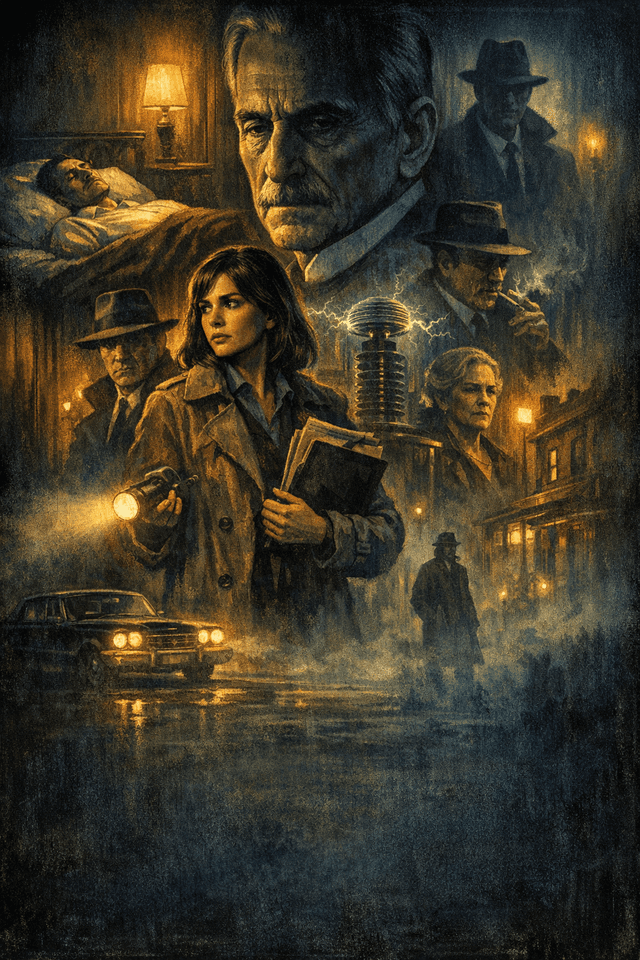
Poster for The Last Invention

The Last Invention

In the shadowy corridors of a New York hotel, the recently deceased Nikola Tesla leaves behind not just his legacy, but unexpected mysteries. A young journalist, determined to uncover the truth about Tesla's final days and the fate of his missing papers, finds herself entangled in a web of intrigue involving government agents, family secrets, and a world skeptical of genius. As she delves deeper into Tesla's life and his revolutionary ideas, she grapples with the question of what knowledge can be weaponized and who gets to decide its fate.

Graphene
Written. Spoken. Yours.
Graphene
Written. Spoken. Yours.
←

The Last Invention

🥽 VR
3 chapters · ~16 min read

novella

In the shadowy corridors of a New York hotel, the recently deceased Nikola Tesla leaves behind not just his legacy, but unexpected mysteries. A young journalist, determined to uncover the truth about Tesla's final days and the fate of his missing papers, finds herself entangled in a web of intrigue involving government agents, family secrets, and a world skeptical of genius. As she delves deeper into Tesla's life and his revolutionary ideas, she grapples with the question of what knowledge can be weaponized and who gets to decide its fate.

Made with EmberKiln
Chapter 1 · ~6 min read

Echoes of a Genius

8:24

Clara said no to the cab. She said it twice, in fact, because the driver had the kind of face that assumed women changed their minds, and she wanted the walk from Thirty-Fourth Street up to the hotel to settle her hands. Six blocks in a January that had teeth. By the time the Hotel New Yorker rose up in front of her, forty-three stories of limestone and electric ambition, her fingers were red enough inside her gloves that she could feel her own pulse in them. She liked that. She liked anything that reminded her she was a body in a place, and not just a byline on its way to becoming one.

•••

The lobby smelled of radiator steam and cold wool. A bellhop was arguing softly with a potted palm, or with something behind it. A woman in a mink was explaining her room number to a man who already knew it. Clara took the elevator because the stairs would have been a performance, and she pressed thirty-three because that was the floor the morning edition had named, discreetly, in the third paragraph of a story that had run above a tire advertisement. The thirty-third-floor corridor was quieter than she expected. Carpet the color of weak tea. Sconces every twelve feet. She counted doors instead of looking at them, which was a trick she had been using since she was nine and had learned, in a hallway not unlike this one, that doors you look at too directly tend to open. Room 3327 was near the end.

•••
“

She liked anything that reminded her she was a body in a place.

The brass plate was polished to a soft grain. Beneath the door, where for weeks, she would later be told, a thin yellow seam of lamplight had burned past three in the morning and sometimes past four, there was now nothing. Just the dark edge of a sill, and the faint smell of a room that had stopped breathing. She stood there for what she decided, later, had been about forty seconds. She did not knock. She did not try the handle. She was a journalist, which was to say she was a person who had learned which rules protected her from finding out things she wasn't ready to find out.

•••

She wrote the number down anyway. Three, three, two, seven. She wrote it in the small notebook she kept in her left coat pocket, which was the pocket closer to her ribs, and she wrote it in pencil because pencil doesn't run if you cry on it. Not that she was going to. She noted the thought and then noted that she had noted it, and then she went back down to the lobby. The concierge desk was staffed by a man of about seventy whose nameplate read VOSS and whose posture suggested he had been standing behind that particular slab of walnut since before the building had a name. He looked up at her approach without hurry. His eyes were pale and courteous and already a little sorry. "Miss," he said.

•••

"I'm with the Herald," Clara said, and showed him the badge that lived on a lanyard around her neck. "I was told I could speak to someone about the long-term residents. For a piece on the hotel." "On the hotel," Mr. Voss repeated, as if testing whether the sentence would hold weight. "Yes. Mr. Ramirez mentioned you might come by." "I'd hoped to see one of the rooms. If a resident were willing." "Most of our residents are quite private." "I understand." "Do you," he said, pleasantly, and she realized it was not a question.

•••

She watched his hands. One of them, the left, had a pale scar that ran from the base of the thumb almost to the knuckle of the index finger, a smooth and shiny stripe that caught the lamp when he moved. He saw her see it and did not move his hand away, which she filed under interesting. "Mr. Voss," she said, more quietly, "the gentleman in 3327." He did not answer immediately. He slid open a shallow drawer under the lip of the desk, and from it he lifted a folded square of newsprint, and he laid it on the walnut between them with the care of a man setting down something hot. His thumb rested lightly on the name in the headline. NIKOLA TESLA, 86, the paper said. INVENTOR. Then smaller, below, the word ALONE, which Clara felt in her sternum before she read it.

•••

"I thought," Mr. Voss said, "that someone would come asking. I did not know it would be today." "Has anyone been in the room?" "The family has made arrangements." "That isn't quite what I asked." He looked at her then with something that was not quite a smile. "No," he said. "It isn't." She waited. He did not fill the silence, which was its own kind of answer. "He believed," Mr. Voss said finally, and stopped, and started again. "He believed he had one piece of work left in him. He said so. More than once. A man that age, you understand, says many things. But he said that one carefully." He paused. "I am not permitted to show you the room, Miss." "I didn't ask." "You were going to."

•••

She took the clipping. He let her. She did not thank him, because thanking him would have made it a gift, and she was not yet sure what it was. "A piece of advice," he said, as she turned, and she turned back. He was looking somewhere past her left shoulder, at a point in the lobby that was not there. "Some men's work outlives them because the world needs it. Some outlives them because the world is afraid of it. It is important, I think, to know which kind you are chasing before you catch it." She nodded once, because she did not trust her voice to be the right size, and she walked back toward the elevators.

•••

She did not go down. She pressed thirty-three again. She wanted, she told herself, one more look at the door. One more look so she would remember it correctly when she wrote it. That was the reason, and it was almost the reason. The corridor on thirty-three was the same corridor. Weak-tea carpet. Sconces. The hush of a building that had been built to feel like it was listening to you. She walked back to 3327 and she stood in front of it again, and this time she did not count. She lifted her hand toward the brass plate and then did not touch it, and let her hand come back down. When she turned to go, she saw, for the first time, the wallpaper.

•••

It was cream. She had registered that already. But the pattern she had taken for a plain damask was not plain, and not a damask. In silver, so fine it only caught the eye at a certain angle, a figure repeated down the length of the hall and around the corner and, presumably, through every corridor of every floor she had already walked without noticing. A jagged mark. A fork. A small, deliberate bolt of lightning, printed in rows, patient as wallpaper is patient, waiting to be seen. Her press badge swung once on its lanyard and settled against her coat. She stood in the hallway a long moment, holding the clipping, and did not yet ask herself the question she had come here to ask.

•••
Next · Ch 2 →
Whispers of Conspiracy
Chapter 2 · ~5 min read

Whispers of Conspiracy

6:50

Clara was already walking when she decided to come back. She got as far as the corner of Eighth and Thirty-Fourth before she turned, the clipping folded into her coat pocket now, the edge of it working against her thumbnail like a loose tooth. The sidewalk was wet with the kind of January slush that soaks through a heel in under a block. She did not notice. She was counting the floors of the hotel in her head, the way a person counts stairs they intend to climb. Inside, she did not approach the desk. Voss was speaking to a woman in a fur collar, his hands folded at his waist the way they had been folded at his waist an hour ago, and Clara understood that whatever she wanted now, she was not going to ask for it.

•••

She took the lobby elevator to the mezzanine instead. From the mezzanine she took the stairs. The trick to belonging in a hotel is to walk as if you have forgotten something you are mildly annoyed about, and Clara, who had spent two years on the city desk being chased out of places, knew the trick. She spoke to a bellman smoking by the laundry chute. She spoke to a maid named Agnes, who had a daughter in Queens and a complaint about the third-floor radiators. She spoke to a night clerk who had come in early and a waiter who remembered carrying warm milk and unsalted crackers up to 3327 every evening at ten minutes past eight, for nine years, until Tuesday. The waiter was the one who said it.

•••

He said Mr. Tesla had asked him, in October, to be careful with the tray. Not the cup. The tray. Because the tray would sometimes carry papers back down, and the papers were not to be touched by anyone, and were to be delivered only to a particular drawer behind the concierge desk. The waiter had done this four times. He had not looked at the papers. He said this twice, which is how Clara understood that he had looked at the papers. She asked what was on them. The waiter said diagrams. He said the word the way a man says a word he has practiced not saying. She was writing none of this down. She had learned, at twenty-four, that a notebook in your hand is a door closing in your face.

•••
“

The trick to belonging in a hotel is to walk as if you have forgotten something you are mildly annoyed about, and Clara, who had spent two years on the city desk being chased out of places, knew the trick.

It was on her way back toward the service stair that she heard the voices. Not voices, exactly. The particular pressure of voices held low on purpose. They were coming up through the grating of a floor vent at the end of a corridor she had no business being in, and she followed the sound the way you follow a draft to find the window that is open.

•••

The service elevator at the end of the hall was propped with a wooden wedge. Beyond it, a half flight down, a sub-basement hallway ran under a row of bare bulbs. Two men stood with their backs to her at a folding card table. Grey suits, identical in the way that two suits are identical when they have been issued rather than chosen. On the table, typed pages. A great many typed pages, in uneven stacks, as if they had been gathered in a hurry and set down with the intention of being sorted later. Clara took one step down. Then another. Then she pressed herself flat against the wall just outside the propped door, where the light did not reach her, and she listened.

•••

One of the men was reading. The other was answering in short syllables. She caught the shape of sentences before she caught the words. Custody. Inventory. Family. The nephew, one of them said, and the other said something she could not hear, and then the first one said, clearly, We take the project or we lose it. The project. She had the word before she had any idea what to do with it. She pressed her palm against the plaster behind her and tried to slow her breathing, which was doing a thing she had not given it permission to do. Down the hall behind her, a bucket struck a baseboard. Agnes, probably. Agnes with her radiator complaint and her daughter in Queens, pushing a cart of linens along a corridor Clara was not supposed to be in. The wheels squeaked once and stopped. Clara did not turn her head.

•••

Below, the reader kept reading. Then the other man said the word weaponized, and the first man's hand came down flat on the nearest page, covering it, as if the word itself might be read off the paper by the ceiling. Clara did not breathe. A long moment. The cart behind her started again, moving away. The men below had gone quiet in the way that people go quiet when they have heard themselves.

•••

Then, briskly, as if a meeting had ended: the scrape of a chair that was not a chair, the shuffle of pages being gathered, a voice saying something about a car and something about tonight. Clara was already moving. She was up the half flight and around the corner and into a linen closet before the first footstep hit the stair, and she stayed there, in the dark, against shelves that smelled of bleach and starch, until the footsteps had passed and the elevator had sighed shut and the building above her had resumed its ordinary noise. When she came out, she went back down. She knew she should not. She went anyway.

•••
“

A notebook in your hand is a door closing in your face.

The sub-basement hallway was empty. The bulbs hummed. The folding table had been overturned, one leg bent at an angle it had not been designed for, and the stacks of paper were gone. All of them, except one. A single typed page was pinned under the bent leg, and the draft from a ventilation grate in the opposite wall was lifting its free corner and setting it down, lifting it and setting it down, the way a hand tests the weight of a thing it has not yet decided to pick up. Clara stood at the bottom of the stairs and looked at it. Then she crossed the hallway to get it.

•••
← Previous · Ch 1
Echoes of a Genius
Next · Ch 3 →
Unraveling Threads
Chapter 3 · ~5 min read

Unraveling Threads

7:48

"You're the one asking about my uncle." The voice came from above her, down the fire escape, and Clara took a step back onto the curb to find its source. A man sat on the second landing in shirtsleeves and a wool vest, no coat, no gloves, as if the January air were a rumor he hadn't yet confirmed. He had Tesla's cheekbones. The resemblance did something to her stomach that she decided not to examine. His shoes were a disgrace. He was turning something small and copper in his fingers, over and over, the way a man worries a rosary. "I'm Clara Weiss," she said. "Herald." "I know who you are. Voss told me. Voss tells me what he thinks I should know." He didn't come down. "Sava Kosanović. I'd say pleased, but."

•••

She climbed the first flight. The iron gave a little under her weight and she paused, and he watched her pause, and something in his face softened by a degree that might have been pity or might have been recognition of a fellow coward. She kept climbing. Up close the copper thing was a coil, no bigger than a spool of thread, wound so finely the wire looked like hair. He didn't offer it and she didn't ask. She sat on the landing two steps below his, which put her eyes level with his scuffed oxfords, and waited.

•••

"He stopped answering letters in thirty-nine," Sava said. "Mine, I mean. Others too, I think, but mine I know. I wrote four times in forty. Birthdays. Christmas. Nothing back. Then last month a telegram from a stranger saying come to the hotel, your uncle is not well. By the time I got the train together he was gone." "I'm sorry." "Don't be. Sorry isn't the shape of it." He flipped the coil. "You want to know about the papers." "I want to know about him." "Everyone says that first." He smiled without using his eyes. "Then they ask about the papers." She let it sit. A truck downshifted on Eighth Avenue. Somewhere inside the hotel a radiator coughed and started up. She thought about the list of questions she'd written on the train and decided not to use any of them. "Who was watching him," she said instead.

•••

Sava stopped turning the coil. "That's not a reporter's question." "It's the one I have." He looked at her for a long moment. She felt him weighing something, not her exactly, something adjacent to her, the shape she made against the fire escape. "The last two years," he said, "he wouldn't take a meal in the dining room. Wouldn't walk in the park. He fed pigeons on the sill because the sill was his. He told my mother, in a letter she showed me after, that his mail was being read before it reached him. She thought he was ill. I thought he was ill. You get to a certain age and people decide what your fears mean before you've finished saying them." "And now?"

•••
“

He reached inside his vest then, under the wool, and brought out a length of grocer's twine.

"Now a man is dead in a locked room and other men I have never met are very interested in what was in it with him." He set the coil down on the iron grate between them, carefully, as if it might roll. "There were articles, you know. The last few years. Little ones, in the back pages. He's senile. He's broke. He's talking to Martians. Printed in papers that used to put him on the cover. A person doesn't fall out of fashion that evenly. Someone rakes the leaves." Clara thought of her editor saying, warmly, the eccentric genius angle, and felt something tilt. "You believe he was discredited on purpose." "I believe," Sava said, "that my uncle spent nine years in a hotel room because a hotel room has one door and he could watch it." She didn't write that down. She would remember it.

•••

He reached inside his vest then, under the wool, and brought out a length of grocer's twine. A key hung at the end of it. Small, brass, older than the hotel by the look of it, with a number filed off the bow so cleanly it had left a bright scar.

•••

"He gave me this in thirty-eight. The only time I saw him after I was a boy. He put it in my hand the way a priest gives you something and said, if ever. Just that. If ever." Sava lifted the twine over his head and held the key out, not dropping it, waiting for her to take it. "The room it opens is in the hotel. It is not on any floor plan drawn after nineteen thirty-eight. Voss knows. Voss has always known. He will not use the key himself. I think he's been waiting for someone to use it who isn't him." She didn't take it yet. "Why me."

•••

"Because you asked the right question and you didn't ask it loud." He tilted his hand. The key swung. "And because I would like, when this is written, for it to say that his family was not what they were made to look like. That I wrote the letters. That I came when I was called, even late. I would like that said." "I can't promise you how a story reads before I've seen what's in it." "No." His hand stayed out. "You can't." She thought about the agents she'd glimpsed in the lobby yesterday, the two men in overcoats who were neither guests nor staff and who had looked at her exactly once, which was the wrong number of times. She thought about Voss's scar. She thought about her own name on a byline and what she would do with it if she had to.

•••

"I'll write what's true," she said. "I'll write that you came." Sava held her eyes another beat and then opened his fingers and let the twine fall into her palm. The key was warm from his chest. "Tonight," he said. "Not tomorrow. I am not a brave man and I keep discovering it." He stood, stiffly, and went up the fire escape instead of down, and she did not watch him go because it felt rude, like watching someone undress. When she looked at the grate again the copper coil was still there. She left it.

•••

Her room at the boarding house on Thirty-Fourth had one window and a lamp that didn't work and a nightstand the color of weak tea. She put the key on the nightstand. She sat on the edge of the bed in her coat and looked at it. The street lamp outside was the old kind, sodium orange, and it came through the thin curtain and caught the brass and threw a shadow of the key along the wall, much longer than the key itself, thin as a needle, reaching almost to the door. She did not get up to close the curtain. She watched the shadow instead, and listened to the building settle, and waited for it to be late enough to go.

•••
← Previous · Ch 2
Whispers of Conspiracy
Back to show →
The Last Invention